
Advice ·
Wines for tonight and wines for twenty years from now: how to keep your bottles well
At TresPiedras we make wines to open tonight and wines meant to wait for years, even to be handed down from parents to children. Getting a bottle to its best moment takes only a few things, but they need looking after. Here is what they are, and which devices are worth having.
A customer asked us a few days ago how to keep the bottles he had just bought from us. It is one of our favourite questions, because behind it lies something very much ours: we make wine thinking of the moment someone opens it, whether tonight or twenty years from now.
Wines to enjoy now
Not every wine is made to wait, nor does it need to be. Nobbis is born to be enjoyed from the moment it leaves the winery: fruit, freshness and the character of our vineyards in Fuentecén and Haza, with no patience required. Keeping some at home is a good idea; forgetting it for many years, less so. Store it well and open it with pleasure.
Wines for the cellar, and for the next generation
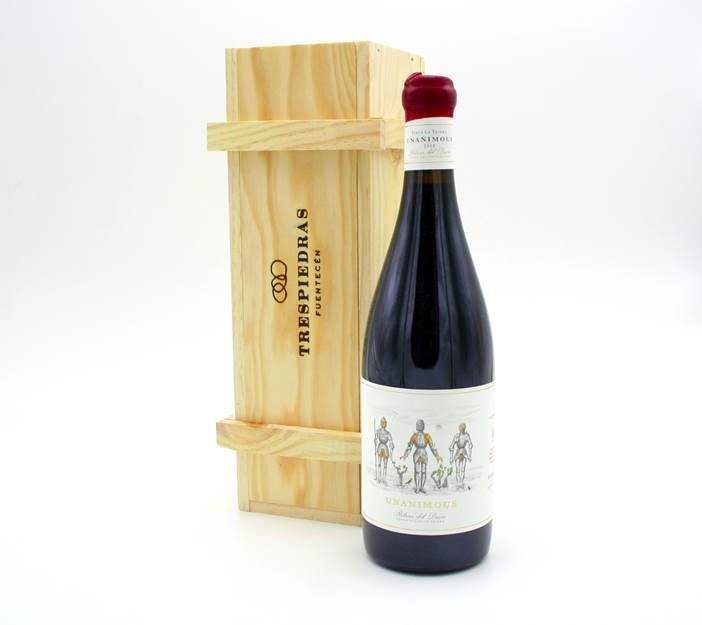
The Unanimous wines are something else. They come from old bush vines, some planted more than a century ago, such as Finca la Tejera and Finca la Maricana, and from long ageing in extra-fine-grain French oak barrels. They have the structure, acidity and depth to evolve for many years in bottle: what is fruit and tension today slowly becomes complexity, with notes of scrubland, leather and spice. Unanimous Santa Cruz, our white from Albillo Mayor vines planted before 1950, is also a white for ageing.
That is why many customers buy a case of one vintage to open a bottle every few years and see how it changes, or to keep it for a purpose: the birth of a child, a wedding, a retirement. A wooden case of a good vintage, well kept, is one of the few gifts that improve with time and can be inherited.
The five keys to keeping wine well
A cool and, above all, stable temperature. Ideally between 12 and 14 °C. More important than the exact figure is that it does not go up and down: sudden changes make the wine expand and contract, and the cork ends up letting air in. A slightly higher but constant temperature is better than one that swings between day and night or between winter and summer.
Enough humidity. Between 60 and 75 % relative humidity the cork stays elastic and seals well. A very dry environment (heating, a fridge) dries it out; one that is too damp ruins the labels and encourages mould.
Darkness. Light, especially sunlight and fluorescent tubes, damages wine. Keep bottles in the dark or in their case.
Bottles lying down and still. Lying flat, the wine touches the cork and the cork does not dry out. Avoid vibrations (washing machines, appliances, busy stairs) and moving bottles around for no reason.
No smells. Cork breathes: do not keep wine next to cleaning products, paint, fuel or strong-smelling food.
Where, at home
A cellar or basement is the best place if you have one. If not, look for the coolest and most stable corner of the house: a cupboard on an inside wall, away from the kitchen, the boiler and the windows. What you should avoid is the kitchen, the top of the fridge, or a cabinet in the sun, however nice it looks. The kitchen fridge is for chilling a bottle before serving, not for keeping it: it is too cold and too dry.
Devices worth having
Wine cabinet. The most practical solution if you have no cellar. For keeping wine for years, choose a compressor model, which holds the temperature even when the room is warm; thermoelectric ones are quiet and vibration-free but fall short in summer and in large sizes. Look for a UV-filter door, humidity control and wooden shelves. Dual-zone models let you keep one part for ageing and another at serving temperature.
Cellar cooling unit. If you want to turn a room, a storeroom or a basement into a cellar, a cooling unit designed for wine cellars (not ordinary air conditioning, which dries the air) keeps temperature and humidity steady all year round. It needs a well-insulated room.
Thermo-hygrometer with logging. A small temperature and humidity meter that records data (some can be checked from your phone) tells you the truth about that corner that seems cool. It is worth leaving it there for a full year before deciding where to keep your wine.
Wooden racks. For a cellar or a cool cupboard, a wooden rack keeps bottles lying down, apart and still, and lets you see what you have without moving them. Original wooden cases, stacked, do the same job.
Needle system with inert gas. It lets you pour a glass by passing a needle through the cork and replacing the wine with argon, without opening the bottle. It is ideal for following how a vintage evolves over the years without using up whole bottles.
Decanter. Essential on the day you open: it separates the sediment of an old wine and helps a young one open up. Wide-mouthed for young wines, narrower for wines with many years behind them.
A few more tips
Keep ageing bottles in their original wooden case: it protects them from light and knocks, and keeps their value if you ever want to give them away or pass them on. Write down in a notebook, or on a sheet inside the case, what you have, which vintage and when you bought it; it helps a lot to open each bottle at its moment.
If you can, buy a magnum too. It is the format in which wine evolves best: there is proportionally less air under the cork, and ageing is slower and finer.
When you are going to open an old bottle, stand it upright a day or two beforehand so the sediment settles to the bottom, and decant it carefully. A young wine also enjoys some time in the decanter, but for another reason: to open up with air.
And if you have any doubts about a particular bottle or vintage, write to us. We love knowing where and how our wines are kept.
- Temperature
- 12–14 °C, stable
- Humidity
- 60–75 %
- Light
- Darkness
- Position
- Lying down, no vibrations
A well-kept wine is a promise kept over the years. If you have a case of Unanimous waiting for its moment, we would love to hear when you open it.
Source: TresPiedras.